Investir à Marrakech : Le Guide Complet pour l'Investisseur Étranger Francophone
Acheter une Villa à Marrakech

Currency Exchange Tips for Morocco Property Buyers
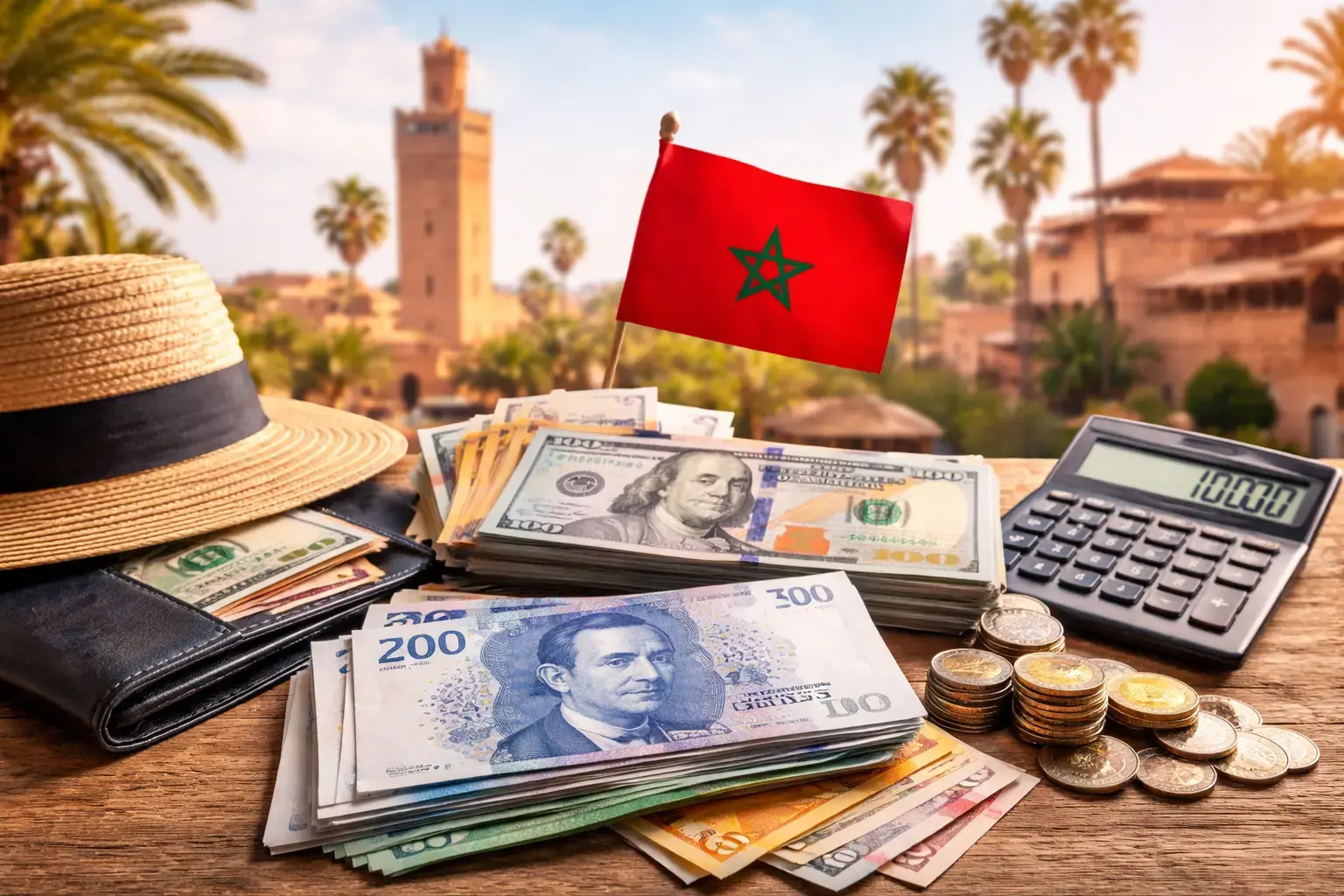
Buying property in Morocco involves much more than finding the perfect home. For foreign investors and Moroccans living abroad (MRE), the question of Morocco currency exchange is a strategic step that can significantly influence the total cost of an acquisition. A poorly planned fund transfer or an unfavourable exchange rate can mean thousands of euros in difference on a real estate transaction.
Understanding the exchange mechanisms, the regulations of the Exchange Office and best practices for international transfers is essential for any buyer wishing to invest with confidence. With Celestia Invest, you benefit from comprehensive support, including the financial aspects of your property project in Marrakech.
Table of Contents
- Currency Exchange Regulations in Morocco
- Understanding the Moroccan Dirham and Exchange Rates
- Transferring Your Funds to Morocco
- Optimising the Exchange Rate for Your Property Purchase
- Special Case for MRE: Foreign Currency Accounts
- Fund Repatriation and Transfer Guarantee
- Hidden Fees and Costs Related to Currency Exchange
- Common Mistakes to Avoid
- Practical Tips for Foreign Buyers
Currency Exchange Regulations in Morocco
The Role of the Exchange Office
In Morocco, all currency exchange operations and international capital transfers are regulated by the Exchange Office (Office des Changes). This body ensures compliance with the regulations governing the movement of currencies into and out of the country. For any foreign investor, understanding this regulatory framework is the first step before carrying out a Morocco currency exchange for a property purchase.
The Exchange Office authorises foreign investments in Moroccan real estate provided that the funds originate from abroad and are channelled through official banking routes. Each transfer must be traceable and justifiable. This requirement protects both the investor and the national financial market by ensuring transaction transparency.
For buyers wishing to become property owners in Morocco as foreigners, it is essential to keep all proof of fund transfers. These documents will be required at the notary signing and will also be needed in the event of a future resale or capital repatriation.
The Convertibility of the Dirham
The Moroccan dirham (MAD) is not a fully convertible currency. This means its value is partly regulated by Bank Al-Maghrib, Morocco's central bank. Since 2018, the exchange rate regime has moved towards greater flexibility, with a fluctuation band widened to +/- 5% against a currency basket composed mainly of the euro (60%) and the US dollar (40%).
This predominance of the euro in the reference basket is good news for European buyers. Fluctuations in the EUR/MAD exchange rate remain relatively contained, offering a degree of predictability when planning a property purchase.
Understanding the Moroccan Dirham and Exchange Rates
EUR/MAD Exchange Rate in 2026
In 2026, the exchange rate fluctuates around 1 EUR = 10.5 to 11 MAD. This range has been relatively stable in recent years, making it easier for European buyers to budget their property projects. A villa listed at 4,500,000 MAD represents approximately 410,000 to 430,000 euros depending on the daily rate.
It is important to distinguish between the interbank rate, displayed on financial platforms, and the actual exchange rate offered by banks and exchange bureaux. The gap between these two rates, called the spread, represents the intermediary's margin. For real estate transactions involving large amounts, even a small difference can have a significant impact.
Factors Influencing the Exchange Rate
Several factors influence the dirham's rate against the euro. The monetary policies of the European Central Bank and Bank Al-Maghrib play a decisive role. Tourism flows, MRE remittances and Morocco's trade balance are also important variables.
For an investor planning a real estate investment in Morocco, it is wise to monitor rate trends over several weeks before making a major transfer. A 2% variation on a 400,000-euro purchase represents an 8,000-euro difference, which is far from negligible.
Transferring Your Funds to Morocco
International Bank Transfer
The SWIFT transfer is the most common and secure method for transferring funds as part of a property purchase in Morocco. Moroccan banks accept transfers in euros, dollars or other major currencies. Conversion to dirhams is carried out automatically upon receipt in the beneficiary's account, at the prevailing rate on that day.
Transfer times vary between two and five business days depending on the bank. It is strongly recommended to initiate the transfer well in advance of the notary signing date. A transfer delay can lead to legal and financial complications, or even jeopardise the entire transaction.
When making the transfer, clearly state the purpose: "real estate acquisition in Morocco". This reference facilitates processing by the banks and serves as important proof for the Exchange Office. The notary will require a foreign currency repatriation certificate, a document issued by the receiving bank in Morocco.
Specialised Transfer Platforms
In addition to traditional bank transfers, certain international transfer platforms offer more competitive Morocco currency exchange rates. These online services often allow savings of between 0.5% and 2% compared to standard banking margins, representing a substantial saving on a transaction worth several hundred thousand euros.
However, for large amounts related to real estate, it is advisable to check the transfer limits allowed by these platforms and their compliance with Moroccan regulations. Funds must pass through an official bank account in Morocco, and the origin of funds must remain fully traceable.
Opening a Bank Account in Morocco
Non-resident foreigners can open a convertible dirham account in Morocco. This type of account is specifically designed to receive funds from abroad and carry out real estate transactions. Major Moroccan banks such as Attijariwafa Bank, BMCE Bank of Africa and Banque Populaire offer this service.
Opening this account is a step we recommend to every foreign buyer. It not only facilitates currency exchange in Morocco at the time of purchase, but also the ongoing management of the property afterwards: paying charges, taxes, renovation costs and collecting rental income. To learn more about the financial aspects of purchasing, consult our guide on financing your property in Marrakech.
Optimising the Exchange Rate for Your Property Purchase
Planning Your Transfers in Advance
One of the best strategies for optimising your Morocco currency exchange for a property purchase is to avoid transferring the full amount in one go. If your purchase timeline allows, splitting the transfer over several weeks helps smooth out rate fluctuations and reduce exchange risk.
For example, for a 400,000-euro purchase, transferring 100,000 euros per week over a month protects you against a sudden unfavourable movement. This approach is particularly relevant during periods of increased volatility on the foreign exchange markets.
Negotiating a Preferential Rate
For real estate transactions involving large amounts, banks often offer a preferential exchange rate. This negotiated rate, better than the standard over-the-counter rate, can be obtained by contacting the international operations department of your bank directly, whether in Europe or Morocco.
The hidden costs of buying property in Marrakech often include exchange margins. Negotiating this rate before the transfer can save you between 2,000 and 5,000 euros on a standard transaction. Do not hesitate to compare your regular bank with other institutions or specialised platforms.
Using Forward Contracts
If your purchase is planned for several months ahead, particularly in the case of an off-plan purchase (VEFA) with staggered payments, a forward exchange contract may be a wise choice. This contract allows you to lock in today's exchange rate for a future date, thus eliminating the uncertainty associated with fluctuations.
This solution is offered by certain banks and specialised brokers. It provides valuable budget certainty, even if the fixed rate is slightly less favourable than the current spot rate. For a VEFA project with payments spread over 12 to 24 months, this strategy allows you to know in advance the exact cost in euros of each instalment.
Special Case for MRE: Foreign Currency Accounts
Specific Advantages for MRE
Moroccans residing abroad benefit from a favourable regulatory framework regarding currency exchange and fund transfers. They can open foreign currency or convertible dirham accounts in Morocco, funded by their income earned abroad. These accounts offer significant flexibility for managing exchange operations related to a property project.
MRE also enjoy more flexible financing conditions from Moroccan banks, with loan terms of up to 15 to 20 years and interest rates between 5.5% and 6.5%. The minimum deposit required is generally 10% to 40% depending on the bank. For a comprehensive guide on MRE advantages, consult our dedicated article on advantages for MRE in Morocco.
Managing a Foreign Currency Account
A foreign currency account allows MRE to keep their funds in euros or dollars and convert them to dirhams only at the right moment, when the exchange rate is favourable. This flexibility is a major asset for optimising Morocco currency exchange in the context of a gradual property purchase or a rental investment.
Rental income earned in Morocco can also be converted and repatriated to the MRE's country of residence, in compliance with current regulations. This transfer guarantee is a reassuring element for any investor wishing to buy in Marrakech while living abroad.
Fund Repatriation and Transfer Guarantee
The Transfer Guarantee for Foreign Investors
Morocco offers foreign investors a transfer guarantee, a fundamental mechanism that deserves to be well understood. When the invested funds come from abroad and the exchange has been carried out correctly through an authorised bank, the investor retains the right to freely repatriate the proceeds from the resale of the property, as well as net rental income after tax.
This guarantee is conditional upon strict compliance with Morocco currency exchange procedures. Every euro transferred must be documented with a foreign currency repatriation certificate. Without this document, the future repatriation of capital may be refused by the Exchange Office, even if the property is resold at a significant profit.
For investors considering a real estate investment in Marrakech, this transfer guarantee serves as an essential safety net. It ensures that your capital remains accessible regardless of how the local property market evolves.
Repatriation Procedure
Upon resale of a property, the repatriation of funds is carried out by international bank transfer from Morocco to the investor's country of origin. The amount that can be repatriated corresponds to the sale price, minus applicable taxes, including the tax on real estate profits. To understand the tax implications in detail, consult our guide on notary fees in Morocco.
The capital gain in dirhams will be converted to euros at the exchange rate prevailing at the time of repatriation. It is therefore possible that the exchange gain or loss between the purchase date and the resale date may affect the overall return on your investment. This is a factor to incorporate into your profitability analysis, in addition to the property's appreciation in dirhams.
Hidden Fees and Costs Related to Currency Exchange
Banking Margins
Every exchange operation involves fees, often poorly visible. Banks apply a spread, meaning a gap between the buying and selling rate of the currency. This spread generally varies between 1% and 3% depending on the institution. On a 400,000-euro transaction, a 2% spread represents 8,000 euros in hidden fees.
In addition to the spread, some banks charge fixed commissions on international transfers, correspondent bank fees (SWIFT fees) and reception fees. Combined, these charges can reach 200 to 500 euros per transfer. It is therefore advantageous to consolidate transfers rather than multiply them.
Impact of Exchange on the Total Budget
For a buyer planning their property purchase process in Morocco, it is essential to include the cost of currency exchange in the overall budget. Here is a concrete example for a villa priced at 4,500,000 MAD:
| Item | Estimated Amount |
|---|---|
| Villa price | 4,500,000 MAD (~420,000 EUR) |
| Notary and registration fees (~10%) | 450,000 MAD (~42,000 EUR) |
| Banking spread cost (1.5%) | ~6,300 EUR |
| SWIFT fees and banking commissions | ~300 EUR |
| Total estimated exchange cost | ~6,600 EUR |
This 6,600 euros in exchange fees represents a significant expense. By optimising the exchange rate and negotiating banking fees, it is possible to cut this cost in half, saving over 3,000 euros.
Common Mistakes to Avoid
Not Keeping Transfer Receipts
The most frequent and costly mistake is failing to keep the foreign currency repatriation certificates. These documents are issued by the Moroccan bank each time funds are received from abroad. Without them, the future repatriation of your investment will be blocked. It is imperative to keep these certificates safely for the entire duration of property ownership.
Exchanging Currency in Cash
Some buyers are tempted to carry cash or use informal channels for Morocco currency exchange when purchasing property. This practice is not only illegal but also deprives the investor of any legal protection. Undeclared funds do not benefit from the transfer guarantee and are not recognised by the notary during the transaction.
Moroccan regulations impose strict limits on the entry and exit of foreign currency in cash. For amounts related to real estate, only official bank transfers are accepted. Respecting this rule is fundamental to securing your property rights in Morocco.
Ignoring Transfer Timing
Transferring the full amount at the last minute, just before signing, exposes the buyer to a double risk: a transfer delay that could jeopardise the transaction, and a potentially unfavourable exchange rate. It is recommended to allow a safety margin of at least two weeks between initiating the transfer and the planned signing date.
Not Declaring the Investment
All foreign investment in Morocco must be declared to the Exchange Office. This declaration, made through the bank, allows you to benefit from legal protection and the transfer guarantee. For acquisitions requiring a VNA (Non-Agricultural Vocation), this financial traceability is even more important. Consult our complete guide to VNA in Morocco to learn more.
Practical Tips for Foreign Buyers
Before the Purchase
Start by opening a convertible dirham account at a Moroccan bank several months before your purchase. This gives you time to compare exchange rates, make progressive transfers and become familiar with the local banking system. Ask your European bank and your Moroccan bank about their respective conditions for international transfers.
Monitor EUR/MAD rate trends and set yourself a target rate. When the market reaches that level, proceed with the transfer. This simple discipline can save you several thousand euros on your purchase in Marrakech.
During the Transaction
Coordinate closely with your notary and your bank to plan the transfer schedule. The notary will tell you the exact amount in dirhams to be paid and the deadline. Anticipate transfer times and any bank holidays in both countries.
Systematically request a foreign currency repatriation certificate for each transfer received in Morocco. Also keep your European bank statements showing the outgoing transfers. This dual documentation is your best protection.
After the Purchase
If you earn rental income in Morocco, managing currency exchange becomes a recurring operation. Income in dirhams can be kept in your Moroccan account to cover ongoing charges (taxes, maintenance, property management), or converted and repatriated to your country of residence.
For day-to-day management, it is often more economical to maintain a dirham balance sufficient to cover annual expenses, rather than multiplying small-amount conversions. An annual or semi-annual transfer of surplus rental income helps minimise exchange costs.
Conclusion: Mastering Currency Exchange for a Successful Investment
Mastering Morocco currency exchange is a key element in the success of your property investment. By understanding the Exchange Office regulations, planning your transfers and negotiating the best rates, you can achieve significant savings on the total cost of your acquisition.
The essential points to remember are as follows. Always transfer your funds by official bank transfer. Carefully keep all foreign currency repatriation certificates. Compare exchange rates between banks and specialised platforms. Split your transfers if your timeline allows. Open a convertible dirham account in Morocco. Declare your investment to the Exchange Office.
At Celestia Invest, we support every buyer in all dimensions of their property project in Marrakech, including the financial and administrative aspects. Our knowledge of the local market and exchange procedures allows us to guide you towards the most advantageous solutions.
Discover our selection of properties in Marrakech and let us guide you towards a secure and optimised investment.
Contact Us
Need advice on currency exchange for your property purchase in Morocco?
Personalised support for international transfers. Connection with the right banking partners. Complete management of your file, from the first visit to handing over the keys.
Phone: +212 688-107270
Email: [email protected]
Website: www.celestiainvest.com
Explore our guides:
- Buying as a foreigner in Marrakech
- Financing your property in Marrakech
- Notary fees guide in Morocco
- Complete real estate investment guide 2025
Celestia Invest - Your real estate partner in Marrakech
© 2026 - Guide updated February 2026

Related Posts
News insight


What does this mean for your project?
Tell us what you are looking for. We will help you identify the properties and the next steps that suit your plans.
Discuss your search