Investir à Marrakech : Le Guide Complet pour l'Investisseur Étranger Francophone
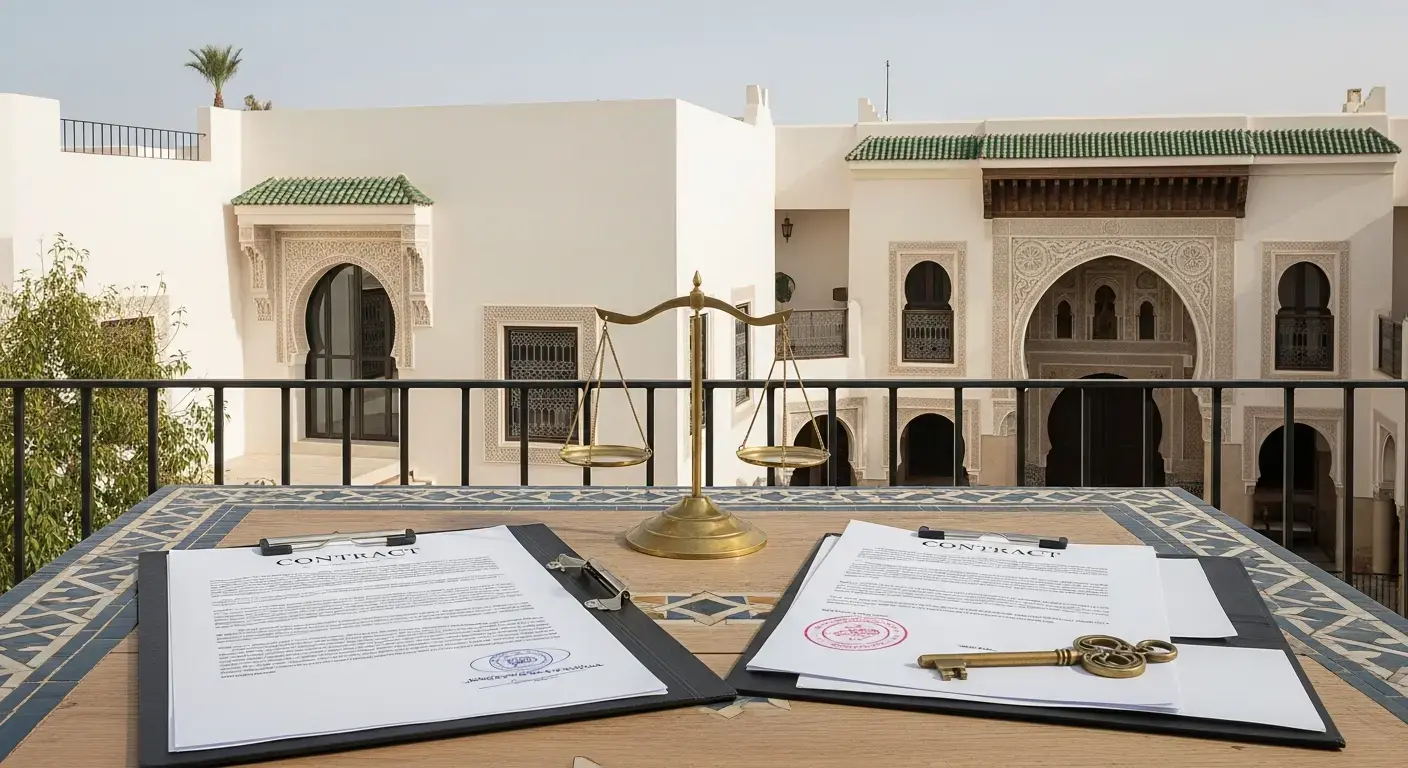
Acheter une Villa à Marrakech

Understanding Property Rights in Morocco: Complete Guide 2026
Morocco offers a solid and attractive legal framework for real estate investment. Understanding property rights in Morocco is fundamental for any investor wishing to acquire property safely. Whether you are a Moroccan Resident Abroad (MRE) or a non-resident foreigner, mastering property rules will allow you to protect your investment and optimize your assets.
This guide details the entire Moroccan land system, different property regimes, possible acquisition methods, and the legal protections you benefit from. With Celestia Invest, discover how to invest confidently in Marrakech and throughout Morocco.
Table of Contents
- The Moroccan Land System
- The Land Title: Key to Legal Security
- Melkia Properties: Untitled Ownership
- VNA: Purchase by Foreigners
- Different Acquisition Methods
- Rights and Obligations of Owners
- Legal Protection of Property
- Taxation and Property Rights
- Transfer and Inheritance
The Moroccan Land System
A Clear and Structured Legal Framework
The Moroccan land system is based on the Real Rights Code, which defines and protects real estate property in the country. This legal framework recognizes full ownership and guarantees owners extensive rights over their property.
Morocco distinguishes several types of land ownership. Registered (titled) property offers maximum legal security. Unregistered property (Melkia) remains common in certain rural areas. Each regime has its characteristics and implications for the investor.
Land administration falls under the National Agency for Land Conservation, Cadastre and Cartography (ANCFCC). This organization manages property registration, issues land titles, and maintains official property records.
Historical Evolution of Land Law
Moroccan land law combines ancestral traditions and legal modernity. The land registration system, introduced in 1913, coexists with the traditional Melkia regime. This duality allows a progressive transition to a complete cadastre while respecting acquired rights.
Since 2011, important reforms have strengthened buyer protection and simplified registration procedures. The digitalization of land services accelerates procedures and improves transaction transparency.
The Land Title: Key to Legal Security
Definition and Importance
The land title is the official document certifying ownership of real estate in Morocco. Issued by the Land Conservation Office, it represents irrefutable proof of property rights. Its probative force is absolute and definitive.
A titled property benefits from maximum legal protection. The land title guarantees the owner's identity, the exact boundaries of the land, and the absence of disputes. This security reassures investors and facilitates all subsequent operations.
For foreigners wishing to buy in Morocco, the land title is essential. It enables obtaining the VNA and definitively secures the transaction.
Content of the Land Title
The land title contains precise and verifiable information. The owner's complete identity appears with their contact details. The detailed description of the property includes area, boundaries, and nature of the land. The history of transfers traces all property transfers.
Charges encumbering the property also appear on the title. Mortgages, easements, or rights of way are mentioned. This transparency protects the buyer against unpleasant surprises and guarantees complete knowledge of the legal situation.
Registration Procedure
Registering an untitled property follows a rigorous procedure. The owner files a requisition with the Land Conservation Office. A surveyor performs the adversarial boundary marking with neighbors. Publication in the Official Gazette opens a two-month opposition period.
In the absence of opposition, the Registrar establishes the land title. The average timeframe varies from 6 to 18 months depending on the complexity of the file. The cost includes surveyor fees, conservation fees, and publication costs.
Melkia Properties: Untitled Ownership
Understanding Melkia
Melkia refers to a traditional property regime based on continuous and recognized possession. It mainly concerns rural or old properties that have never been registered. Proof of ownership relies on adoulaire deeds (traditional notaries) and testimonies.
A Melkia property can be sold, rented, or transferred by inheritance. However, legal security remains lower than that of a titled property. Neighborhood disputes or third-party claims are more difficult to settle definitively.
To learn more, consult our complete guide to Melkia in Morocco.
Advantages and Disadvantages
Buying a Melkia property has certain advantages. Prices are generally 20 to 40% lower compared to equivalent titled properties. Supply is more abundant in rural or peri-urban areas. The purchase procedure can be faster initially.
The disadvantages deserve attention. The absence of a land title complicates obtaining a bank loan. Resale to a foreigner requires prior registration. Risks of disputes or claims exist, even after several decades of peaceful possession.
Conversion to Land Title
Converting a Melkia to titled property is possible and recommended. The owner initiates a registration procedure with the Land Conservation Office. Required documents include adoulaire deeds, the topographic plan, and proof of possession.
The conversion timeframe varies from 12 to 24 months. The total cost represents approximately 3 to 5% of the property value. This investment definitively secures the property and enhances the assets.
VNA: Purchase by Foreigners
Principle of Non-Agricultural Vocation
The VNA (Non-Agricultural Vocation) is the essential authorization for a foreigner to acquire real estate in Morocco located on initially agricultural land. This procedure ensures that the property will be used for residential, commercial, or tourist purposes.
The VNA is not simply an administrative formality. It modifies the legal nature of the land and officially assigns it a non-agricultural vocation. Without VNA, even an existing construction cannot be legally sold to a foreign buyer.
Discover our complete VNA guide for Morocco to master this essential procedure.
Projects Concerned by VNA
Several categories of properties require VNA for sale to a foreigner. Existing constructions authorized on converted agricultural land are included. Villas within approved housing developments are also included. Validated tourist projects such as guesthouses, riads, and tourist residences are concerned.
These projects generally benefit from clear compliance with the approved development plan. Their legal structure allows international sale in complete legality.
Role of the CRI in the Process
The Regional Investment Center (CRI) plays a central role in processing VNA files. It coordinates the project study with competent technical services: urban planning, agriculture, environment, and local authorities.
The CRI verifies project compliance with the development plan and regional master plan. It organizes analysis committees and issues necessary opinions. For foreign investors, the CRI represents a one-stop shop facilitating procedures.
Mandatory Verifications
Before any purchase, foreign investors must imperatively verify several elements. The existence of a formal and written VNA is paramount. Project compliance with the building permit and development plan must be confirmed. Approval by local committees via the CRI is essential.
The validity of the land title or property certificate requires thorough verification. Any exemptions must be officially registered with the CRI. These checks avoid unpleasant surprises and secure the investment.
Different Acquisition Methods
Purchase in Personal Name
Purchase in personal name represents the most common and simplest form of real estate acquisition in Morocco. The property is directly registered in the buyer's name on the land title. This formula is perfectly suited for personal purchases or first investments.
Legally, the operation is direct without complex intermediaries. The owner enjoys full ownership, free to sell, rent, or occupy the property. Moroccan law recognizes this full ownership protected by the Real Rights Code.
Taxation includes registration fees at 4% of the purchase price. Notary and land conservation fees are added, approximately 1.5 to 2%. In case of resale with capital gain, the tax on real estate profits applies at 20%, with a minimum of 3% of the sale price. An exemption is possible if the property has been the main residence for more than 6 years.
Consult our article on the real estate purchase process in Morocco for more details.
Joint Ownership Acquisition
Joint ownership allows multiple people to buy together: spouses, family members, or investment partners. Each person holds a share of the property expressed as a percentage. This formula pools resources while sharing rights.
Joint ownership is governed by the Moroccan Real Rights Code. Each co-owner has the same usage and decision rights in proportion to their share. Any major decision requires everyone's agreement: sale, mortgage, or major works.
Taxation is proportional. Each co-owner pays registration fees and taxes according to their share. In case of resale, each declares and pays capital gains tax corresponding to their share.
A joint ownership agreement drafted by a notary is strongly recommended. It prevents deadlocks and organizes property management. Without it, a co-owner can request judicial partition in case of persistent disagreement.
Acquisition via LLC (SARL)
The SARL (Limited Liability Company) is the preferred structure for professional real estate investment in Morocco. It separates personal assets from real estate assets, optimizes taxation, and facilitates transfer.
Governed by law 5-96, the SARL can be formed by a single person (single-member SARL) or several. Partners' liability is limited to their contributions. Partners can be Moroccan or foreign.
Taxation is advantageous for active investors. The SARL is subject to Corporate Tax: 12.5% on profits below 300,000 dirhams, 20% beyond. Rental income is taxed after deduction of expenses: management fees, depreciation, works, loan interest. VAT may be recoverable in certain cases.
In terms of assets, transfer is facilitated by the sale of shares. The structure accommodates several partners, including heirs. This formula is ideal for a rental portfolio or real estate development activity.
Real Estate Civil Company (SCI)
The SCI mainly serves to manage family assets or organize transfer over several generations. Less common in Morocco than the SARL, it meets specific asset management needs.
SCI partners are personally liable for the company's debts, unlike the SARL. Taxation can be transparent (income tax) or subject to corporate tax by option. This flexibility allows adapting the structure to each situation.
The SCI is suitable for families wishing to preserve and transfer real estate assets. It is less suitable for investors seeking immediate profitability or maximum protection of personal assets.
Comparison of Acquisition Methods
| Criteria | Personal Name | Joint Ownership | SARL | SCI |
|---|---|---|---|---|
| Simplicity | Very simple | Simple | Medium | Medium |
| Asset protection | No | No | Yes | No |
| Tax optimization | Limited | Limited | High | Medium |
| Transfer | Inheritance | Complex | Share sale | Share sale |
| Creation cost | None | Low | 10,000-20,000 MAD | 8,000-15,000 MAD |
| Ideal profile | Main residence | Family purchase | Rental investment | Family management |
Rights and Obligations of Owners
Owner's Rights
Real estate owners in Morocco enjoy extensive rights recognized by law. The right of use allows personally occupying the property or leaving it vacant. The right of enjoyment authorizes collection of rental income. The right of disposal allows freely selling, giving, or mortgaging.
The owner can carry out all construction, renovation, or development work in compliance with urban planning regulations. They can fence their land, plant trees, and exploit the resources of their soil. These rights are exercised within the limits set by law and without harming neighbors.
Property also includes the subsoil and airspace above the land, within legal limits. The owner can therefore build underground or in height according to applicable urban planning rules.
Owner's Obligations
Property comes with legal and tax obligations. The owner must pay local taxes: housing tax, municipal services tax, tax on built or unbuilt property. These taxes fund local public services.
Property maintenance is the owner's responsibility. They must maintain the construction in good condition and avoid dangers to the neighborhood or public road. Facades must be maintained according to municipal rules. Fences and party walls are subject to shared obligations.
The owner must respect legal or conventional easements encumbering their property. Right of way, view over neighbor, water drainage: these constraints limit absolute enjoyment but preserve neighborhood harmony.
Rights of Foreign Property Owners
Foreign property owners in Morocco enjoy the same rights as nationals on their non-agricultural vocation properties. They can freely occupy, rent, or resell. Repatriation of rental income and sale proceeds is guaranteed by exchange regulations.
MRE (Moroccans Residing Abroad) benefit from additional advantages. They have access to mortgages under favorable conditions. Financing duration can reach 15 to 20 years with rates of 5.5 to 6.5%. To learn more, consult our article on advantages for MRE in Morocco.
Legal Protection of Property
The Role of the Notary
The notary intervenes mandatorily in real estate transactions in Morocco. They authenticate sales deeds and give them enforceable force. Their presence guarantees the legal validity of the transaction and protects both parties.
The notary performs essential verifications before signing. They check the land title and absence of undisclosed charges. They verify the parties' capacity to contract. They ensure the property's compliance with urban planning rules.
Notary fees in Morocco include their fees and registration duties. They represent approximately 6 to 8% of the acquisition price. These fees are borne by the buyer unless otherwise agreed.
The Sales Agreement
The sales agreement legally binds seller and buyer before the final deed. This document sets the transaction conditions: price, deadlines, conditions precedent. It secures the transaction during the preparation period of the final deed.
Conditions precedent protect the buyer against certain risks. Obtaining bank financing, VNA delivery, or urban planning regularization may condition the sale. If these conditions are not met, the buyer recovers their deposit.
Occupancy Permit and Certificate of Conformity
The occupancy permit and certificate of conformity certify that construction complies with urban planning rules and safety standards. These documents are essential for any sale of constructed property.
Without an occupancy permit, property cannot be legally occupied or sold. The buyer faces administrative complications or even sanctions. Verification of these documents is part of essential preliminary checks.
Consult our guide on occupancy permit and certificate of conformity in Morocco to learn everything about these formalities.
Taxation and Property Rights
Acquisition Taxes
Acquiring real estate in Morocco generates several taxes. Registration fees represent 4% of the purchase price for residential properties. They reach 6% for unbuilt land or commercial premises.
Land conservation fees are added at 1.5% of the price. Notary fees vary from 0.5 to 1% depending on the transaction amount. Total acquisition costs represent approximately 6 to 8% of the property price.
Taxes During Ownership
The owner pays several local taxes annually. The housing tax applies to main and secondary residences. The municipal services tax finances local infrastructure. The tax on unbuilt land aims to encourage construction.
Rental income is subject to tax. In personal name, the flat rate is 10% on gross income. In a company, income is taxed at corporate tax after deduction of expenses. The most advantageous regime depends on the income level and deductible expenses.
Resale Taxes
Reselling property with capital gain generates the tax on real estate profits (TPI). The rate is 20% on the difference between sale price and purchase price, after deduction of justified expenses. A minimum of 3% of the sale price applies in all cases.
Exemptions exist. Main residence occupied for more than 6 years escapes the TPI. Properties held for more than 10 years benefit from a reduction. These rules encourage long-term investment.
Transfer and Inheritance
Inheritance Rules
Transfer of real estate in Morocco follows inheritance law rules. For Muslim Moroccans, the Family Code applies with its specific distribution rules. For foreigners, their national law may apply according to international conventions.
Estate planning allows anticipating transfer. Creating a company (SARL or SCI) facilitates gradual transfer of shares to heirs. Lifetime donation remains possible under certain tax conditions.
Inheritance Duties
In Morocco, inheritance duties on real estate are relatively moderate. Registration of inheritance transfer generates limited fixed fees. Transfer between ascendants and descendants benefits from a favorable regime.
For foreigners, international tax conventions avoid double taxation. France, Belgium, Spain, and other countries have signed agreements with Morocco. These treaties secure international transfer of assets.
Off-Plan Purchase (VEFA) and Property Rights
VEFA Particularities
VEFA (Sale in Future State of Completion) allows acquiring property before its complete construction. The buyer pays deposits according to work progress. Ownership transfers progressively until final delivery.
In Morocco, VEFA is governed by laws 44-00 and 107-12. These texts impose mandatory mentions in the preliminary contract and provide certain completion guarantees. However, protections remain lower than European standards.
Securing Your VEFA Investment
Off-plan acquisition presents specific risks. Before the property has a parcel land title, it is not eligible for bank credit or mortgage. The buyer must therefore generally finance with own funds or accept the installment plan proposed by the developer.
Several precautions are necessary. Verifying the developer's reputation and solvency is essential. Never pay large sums directly to a personal account. Request written guarantees and have contracts reviewed by a professional. Follow work progress with documented evidence.
To explore this topic further, consult our article on off-plan purchase vs resale villa in Marrakech.
Conclusion: Invest with Full Knowledge
Property rights in Morocco offer a clear and protective legal framework for investors. The land system distinguishes titled property and Melkia, each with its advantages. Foreigners access property via the VNA procedure validated by the CRI.
The choice of acquisition method depends on your profile and objectives. Purchase in personal name suits main residences. Joint ownership allows family purchases. The SARL optimizes rental investment and protects personal assets.
Owner's rights are extensive: use, enjoyment, and disposal of property. Obligations include paying taxes and maintaining the property. Legal protection comes through the notary, land title, and rigorous preliminary verifications.
At Celestia Invest, we support each investor to secure their acquisition. Complete document verification, personalized advice on the appropriate acquisition method, notarial support: our expertise guarantees a serene investment.
Discover our properties for sale and benefit from personalized support for your real estate project in Morocco.
Contact Us
Want to invest safely in Morocco?
Complete legal analysis of your project. Personalized advice on acquisition method. Expert support at every step.
Phone: +212 688-107270
Email: [email protected]
Website: www.celestiainvest.com
Our additional resources:
- Real Estate Investment Guide in Morocco
- Buying a Villa in Marrakech
- Luxury Riad Buying Guide in Marrakech
- Best Neighborhoods in Marrakech
Celestia Invest - Your Real Estate Partner in Morocco
© 2026 - Guide updated January 2026

Related Posts
News insight
What does this mean for your project?
Tell us what you are looking for. We will help you identify the properties and the next steps that suit your plans.
Discuss your search