Investir à Marrakech : Le Guide Complet pour l'Investisseur Étranger Francophone
Acheter une Villa à Marrakech

How to Buy Property in Marrakech as a Foreigner
Buying property in Marrakech as a foreigner represents an exceptional investment opportunity in one of North Africa's most dynamic real estate markets. Marrakech attracts thousands of international investors each year, drawn by its climate, culture and profitability potential.
Whether you're looking for a luxury villa, a traditional riad in the medina or a rental property, understanding the administrative and legal procedures is essential to secure your investment.
This comprehensive guide walks you through all the steps of buying property in Morocco. With Celestia Invest, benefit from expert support to make your project a reality with complete peace of mind.
Table of Contents
- Foreigner Rights in Morocco
- VNA: Essential Condition for Foreigners
- Property Types Accessible to Foreigners
- Financing Options for Foreign Investors
- Choosing the Right Acquisition Structure
- Steps of Property Purchase
- Applicable Taxation and Taxes
- Buying Off-Plan (VEFA): Precautions to Take
- Tourism Exploitation and Rental
- Advice to Secure Your Investment
Foreigner Rights in Morocco
Property Rights for Foreigners
Morocco authorizes foreign investors to acquire real estate on its territory. Foreigners benefit from the same property rights as Moroccan citizens, with certain specific conditions.
Nationals of all countries can buy in Morocco. No reciprocity condition is required. Properties are protected by the Moroccan Real Rights Code. Succession transmission is guaranteed according to international rules.
Specific Restrictions
Agricultural land: Land initially classified as agricultural requires a Non-Agricultural Vocation (VNA) authorization to be sold to foreigners. This procedure legally transforms the land status.
Strategic zones: Certain border or military zones may be subject to restrictions. However, these cases are exceptional for Marrakech residential areas.
Administrative Procedures
Acquisition by a foreigner requires specific documents. Valid passport. Proof of residence in country of origin. Proof of funds origin (bank statements, attestations). Moroccan tax identification number (obtained upon acquisition).
No prior government authorization is required for purchasing residential properties with VNA. The process remains simple and transparent with appropriate professional support.
VNA: Essential Condition for Foreigners
What is VNA?
The Non-Agricultural Vocation (VNA) is an administrative act that modifies the legal status of land or a project, making it saleable to foreign investors. It's the legal guarantee that the property can be acquired in full compliance.
VNA secures the legality of construction. It formally authorizes sale to a foreign buyer. It confirms compliance with local urban planning standards. Without VNA, an existing property may be legally unsaleable to a foreigner.
Types of Projects with VNA
Authorized constructions: Existing villas in approved subdivisions. Properties located in regular housing groupings. Validated tourism projects (guest houses, riads, tourist residences).
Characteristics of VNA properties: Clear compliance with development plans. Legal structure allowing international sale. Validation by the Regional Investment Center (CRI). Complete and official documentation.
Mandatory Verifications
Before any purchase, foreign investors must imperatively verify the existence of a formal written VNA. Compliance of the project with the building permit. Approval by local commissions via the CRI. Validity of land title or property certificate.
The CRI plays a central role by coordinating the study with technical services (urban planning, environment). It verifies compliance with the regional development plan. It organizes analysis commissions and issues necessary opinions.
Individual VNA Deadlines and Costs
If the property does not yet have VNA, the complete procedure requires 6 to 12 months. Cost varies according to land area: 50,000 to 200,000 MAD.
Expert advice: Never buy a property without validated VNA if you are a foreigner. This condition is absolutely non-negotiable to secure your investment. For more details, consult our complete VNA guide.
Property Types Accessible to Foreigners
Villas and Individual Houses
Villas represent the most sought-after property type by foreign investors in Marrakech. Contemporary or traditional Moroccan architecture. Generous plots (1,000 to 5,000 m²). Swimming pool and landscaped gardens. Atlas or Palmeraie views.
Popular areas: Palmeraie, Ourika Road, Ouarzazate Road, golf courses (Amelkis, Al Maaden, Royal Palm).
Prices: 4-bedroom quality villa: 3,000,000 to 8,000,000 MAD. Luxury 6+ bedroom villa: 8,000,000 to 25,000,000 MAD.
Riads in the Medina
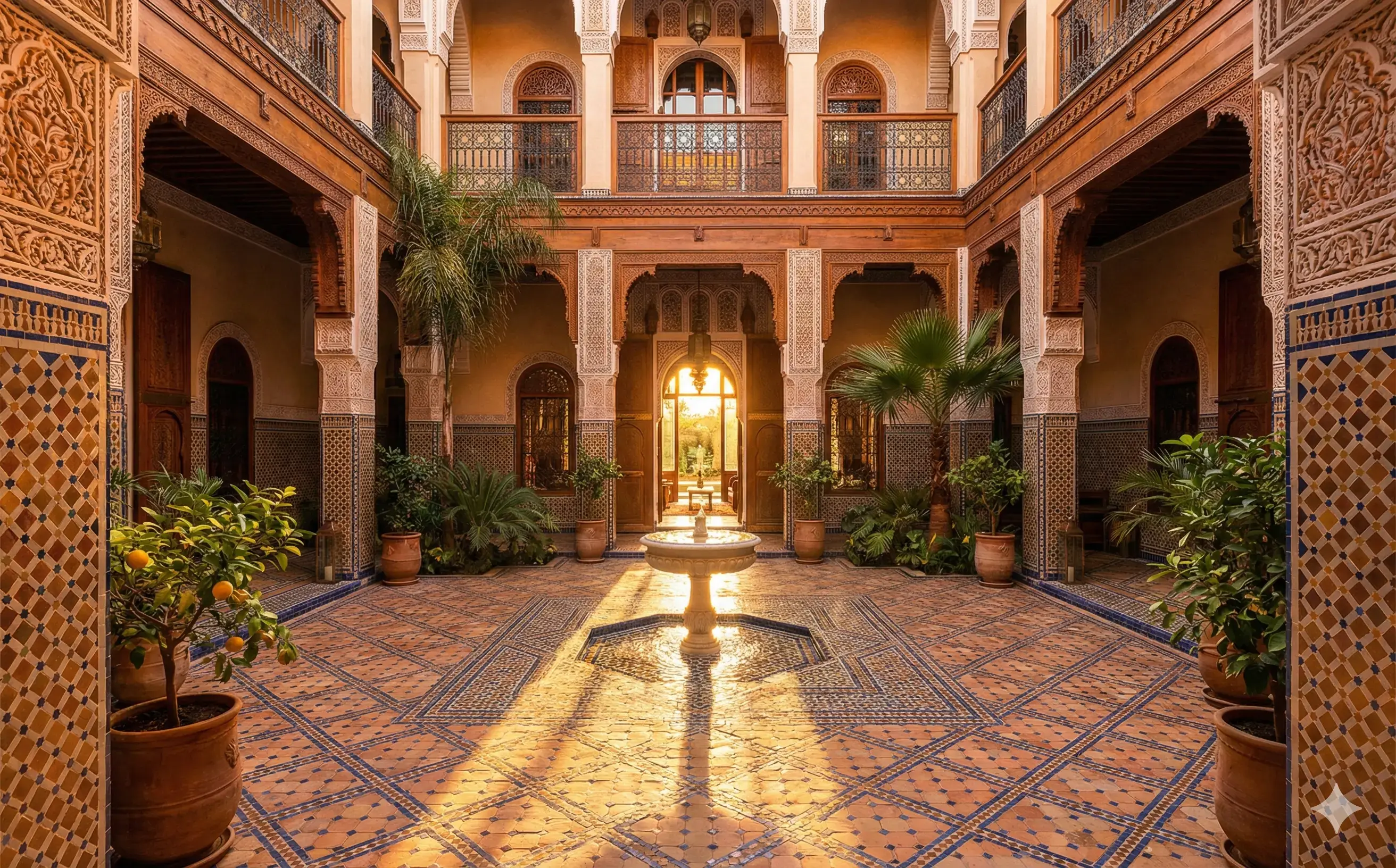
Riads offer an authentic experience of traditional Moroccan architecture. Central courtyard with fountain or basin. Panoramic terraces with medina or Atlas views. Preserved architecture (zellige, tadelakt, carved woodwork). High tourism exploitation potential.
Advantages: Unique authentic character. Strong tourism rental demand. Heritage appreciation. Constraints: Sometimes difficult access (narrow alleys). Renovation work often necessary. More complex daily management.
Prices: 3-4 bedroom riad: 2,000,000 to 5,000,000 MAD. Luxury 5+ bedroom riad: 5,000,000 to 15,000,000 MAD.
Apartments and Residences
Apartments are particularly suitable for investors seeking ease of management. Secure residences with services. Modern neighborhoods (Gueliz, Hivernage, M Avenue). Urban amenities (shops, restaurants, transport).
Prices: 2-bedroom apartment: 1,200,000 to 2,500,000 MAD. 3-4 bedroom apartment: 2,500,000 to 6,000,000 MAD. Luxury penthouse: 6,000,000 to 15,000,000 MAD.
Tourism Projects
Experienced investors can acquire guest houses or hotels. Professional operation with significant income. Multiple rooms (5 to 15+). Complete facilities (restaurant, spa, pool). Mandatory tourism licenses.
Investment: 5-8 room guest house: 8,000,000 to 20,000,000 MAD. Boutique hotel 15+ rooms: 20,000,000 to 60,000,000 MAD and more.
Financing Options for Foreign Investors
Cash Purchase (100% Own Funds)
Cash purchase remains the simplest and most common solution for foreign investors in Morocco. Fast and secure acquisition. Simplified file for authorities. Total freedom in property management and resale. No interest charges.
Advantages: Accelerated process (signature in 4-8 weeks). Strengthened negotiating power with seller. No banking constraints. Conditions: Fund transfer from abroad via official banking channels. Preservation of transfer receipts (mandatory for future resale). Declaration to Foreign Exchange Office if large amount.
Bank Loan in Morocco
Moroccan banks and foreign subsidiaries offer mortgage loans to foreigners, with specific conditions.
Conditions for Non-Resident Foreigners
| Criterion | Details |
|---|---|
| Maximum duration | 10 years |
| Minimum down payment | 30 to 50% of price |
| Interest rate | 6% to 8% depending on profile |
| Required income | Proof of stable income abroad |
| Guarantees | Mortgage on property + possible guarantee |
| Documentation | Passport, residence certificate, bank references |
Conditions for Moroccans Living Abroad (MRE)
MRE benefit from more advantageous conditions. Duration up to 15-20 years. Minimum down payment 10-40% depending on bank. Interest rate 5.5% to 6.5%. More flexible conditions than for non-residents.
To learn more, consult our article on advantages for MRE in Morocco.
Financing Example
Villa purchase 5,500,000 MAD with credit:
| Element | Amount |
|---|---|
| Villa price | 5,500,000 MAD |
| Personal down payment 60% | 3,300,000 MAD |
| Bank loan 40% | 2,200,000 MAD |
| Duration | 10 years |
| Rate | 6.5% |
| Monthly payment | ~25,000 MAD |
| Cumulative interest | ~1,000,000 MAD |
Bank Negotiation Strategies
Compare several banking institutions to get the best rate. Highlight a high down payment (possible reduction of 0.5 to 1%). Prepare a complete and solid file (increases chances of obtaining). Use a broker or local expert (facilitates negotiations).
Banking rules: Monthly payments should not exceed 35-40% of monthly income. Banks may require fund transfer from abroad. Rates can be fixed or variable depending on institutions.
Off-Plan Credit (VEFA)
Off-plan properties without definitive land title are not eligible for traditional bank credit. Alternative: installment payment proposed by developer (generally 12 to 24 months). This option allows spreading the investment until obtaining the parcel title.
Caution: VEFA in Morocco involves specific risks that we detail in the dedicated section below.
Choosing the Right Acquisition Structure
Purchase in Own Name (Individual)
This is the most common and simplest formula for a personal purchase in Marrakech. The property is registered directly in your name on the land title.
Advantages: Direct operation without complex legal intermediary. Full ownership with freedom to sell, rent or occupy. Fast process and reduced fees.
Taxation: Registration fees 4% of purchase price. Notary and land registry fees ~1.5 to 2%. Capital gains tax on resale: 20% (minimum 3% of sale price). Possible exemption if primary residence for over 6 years. Rental income taxed at Income Tax (IR) at 10% of gross income.
Suitable for: Primary or secondary residence purchase. First simple investment. Personal ownership without significant commercial objective.
Joint Ownership Acquisition
Buying with others (spouses, family, partners) where each person holds a share of the property expressed as a percentage.
Advantages: Simplicity and flexibility at creation. Allows pooling financial resources. Sharing responsibilities and costs.
Disadvantages: Complicated management requiring everyone's agreement. Risk of blockage if disagreement between co-owners. Sometimes heavy succession transmission. Possible judicial partition in case of conflict.
Practical advice: Have a joint ownership agreement drafted by a notary defining each person's rights and obligations, management procedures and exit conditions.
Acquisition via SARL (Limited Liability Company)
The SARL is the preferred structure for professional real estate investment in Morocco. It allows separating personal assets from real estate assets.
Legal aspects: Partner liability limited to contributions. Personal asset protection. Possible incorporation by a single person (single-partner SARL). Partners can be Moroccan or foreign. Regulated transfer of shares.
Advantageous taxation: Corporate Tax (IS) at progressive rate:
- 12.5% on profits below 300,000 MAD
- 20% beyond 300,000 MAD
Rental income taxed at IS after deducting expenses. Possibility to deduct: management fees, depreciation, maintenance work, loan interest. VAT recoverable in certain specific cases.
Asset advantages: Transmission facilitated by transfer of shares. Sustainable structure that can accommodate multiple partners or heirs. Ideal for building a rental portfolio or real estate development activity.
Suitable for: Investors with portfolio of multiple properties. Professional rental activity (guest house, intensive seasonal rental). Structured estate transmission projects. Sought tax optimization.
Real Estate Civil Company (SCI)
Less used in Morocco, the SCI mainly serves to manage family assets or organize intergenerational transmission.
Particularities: Partners personally liable for company debts. Transparent taxation (IR) or option for IS. Suitable for families wishing to preserve and transmit assets over several generations. Less adapted to investors seeking immediate profitability.
Acquisition via Foreign Company
Certain foreign companies can buy in Morocco, particularly in tourism or industrial zones.
Obligations: Mandatory investment declaration to Foreign Exchange Office. Strict compliance with land regulations (especially agricultural land). Compliance with international conventions.
Taxation: Income taxed locally in Morocco. Application of double taxation avoidance conventions (France, Spain, Belgium, etc.). Increased administrative complexity requiring specialized legal advice.
Structure Comparison Table
| Structure | Taxation | Asset Protection | Complexity | Ideal for |
|---|---|---|---|---|
| Own name | IR + 4% fees | Low | Simple | Personal residence |
| Joint ownership | Proportional IR | Low | Medium | Couple/family purchase |
| SARL | IS 12.5-20% | High | Medium-High | Professional rental investment |
| SCI | IR or IS option | Medium | High | Family transmission |
| Foreign company | IS + conventions | High | Very high | Large investors |
Steps of Property Purchase
Step 1: Define Your Project
Clarify your investment objectives. Primary residence, secondary or rental investment. Available overall budget (acquisition + fees + work). Preferred geographical areas in Marrakech. Type of property sought (villa, riad, apartment).
Budget to plan: Property purchase price. Acquisition fees (approximately 10% of price). Possible renovation or customization work. Furnishing. Working capital (6 months of charges).
Step 2: Search and Viewings
Collaborating with a specialized agency like Celestia Invest guarantees access to a rigorous selection of compliant properties. Organized viewings of preselected properties. Local expertise on neighborhoods and opportunities. Total transparency on property history.
Points of vigilance during viewings: General condition of property and construction compliance. Quality of finishes and materials. Immediate environment and neighborhood. Access and amenities (water, electricity, internet). Available documentation (titles, permits, VNA).
Step 3: Legal Verifications
Before any purchase offer, thorough verifications are essential. Land title verification at Land Registry. VNA confirmation (mandatory for foreigners). Building permit and urban planning compliance verification. Search for charges, mortgages or easements. Seller identity and legal capacity check.
Documents to obtain: Certified true copy of land title. Recent property certificate (less than 3 months). VNA certificate validated by CRI. Building permit and compliance certificate. Tax clearances (local taxes up to date). Architectural and technical plans.
Step 4: Purchase Offer and Preliminary Agreement
Once the property is selected and verifications satisfactory, formalize your purchase intention.
Written purchase offer: Document not mandatory but recommended. Specifies proposed price and conditions. Generally accompanied by symbolic deposit (10,000 to 50,000 MAD). Valid for a few days to a few weeks.
Promise to sell or preliminary agreement: Preliminary contract binding seller and buyer. Final price and payment terms. Possible suspensive conditions (credit obtaining, additional verifications). Deadline for final sale completion (generally 2-3 months). Down payment (10 to 20% of total price).
To understand suspensive conditions, consult our guide on suspensive conditions of a sale agreement in Morocco.
Step 5: Preparation of Final Deed
The notary (Adoul in Morocco) prepares the authentic sale deed. Final verification of all documents. Calculation of registration fees and notary fees. Coordination with Land Registry. Preparation of tax declarations.
Typical deadline: 4 to 8 weeks between preliminary agreement and final signature for a cash purchase. 8 to 12 weeks if bank credit involved.
Step 6: Deed Signature and Payment
Signature of authentic deed at notary's office in presence of all parties. Payment of balance of sale price. Payment of notary fees and registration fees. Delivery of keys and property documents.
Payment methods: Secure bank transfer (recommended). Certified or bank check. Preservation of payment proofs (mandatory for future resale).
Step 7: Registration and Post-Acquisition Formalities
Deed registration at Land Registry (official property transfer). Registration on land title in new owner's name. Obtaining updated property certificate. Declaration to Foreign Exchange Office if fund transfer from abroad. Home insurance subscription. Change of service contracts (water, electricity, internet).
Registration deadline: 2 to 6 weeks for complete registration at Land Registry.
Summary of Acquisition Fees
| Item | Percentage | Example (property 4,000,000 MAD) |
|---|---|---|
| Registration fees | 4% | 160,000 MAD |
| Notary fees | 1% to 1.5% | 40,000 to 60,000 MAD |
| Land registry | 0.5% to 1% | 20,000 to 40,000 MAD |
| Agency fees | 2% to 3% | 80,000 to 120,000 MAD |
| Miscellaneous fees (expert, lawyer) | 0.5% | 20,000 MAD |
| TOTAL | ~8.5% to 10% | 320,000 to 400,000 MAD |
For more details, consult our guide to notary fees in Morocco.
Applicable Taxation and Taxes
Acquisition Taxes
Registration fees: Standard rate of 4% of purchase price or market value (whichever is higher). Paid by buyer when registering deed. Calculated on price declared in authentic deed.
Real estate VAT: Mainly applies to new properties sold by developer. Standard rate of 20% on sale price. Included in price displayed by developers. Possible exemption for certain social housing or specific programs.
Annual Ownership Taxes
Housing tax: Paid by property occupant (owner or tenant). Variable amount depending on municipality and rental value. Generally between 10,000 and 40,000 MAD/year for a villa.
Municipal services tax: Related to municipal services (garbage collection, public lighting). Modest amount (a few thousand MAD annually).
Undeveloped land tax: Applicable if you own bare land. Tax incentive to build. Progressive rate according to non-construction duration.
Rental Income Taxation
Simplified regime (Individual): Flat rate of 10% on gross rental income. No expense deduction possible. Simplified annual declaration. Suitable for small owners.
Actual regime (SARL or option): Taxation on net income after deducting expenses. Deductible expenses: management fees, maintenance work, depreciation, loan interest, insurance, local taxes. Rigorous accounting obligation. Allows significant tax optimization.
Real Estate Profit Tax (Capital Gains)
When reselling a property, realized capital gain is taxable. Rate of 20% on net capital gain. Minimum levy: 3% of sale price (even in case of loss).
Capital gain calculation: Gross capital gain = Sale price - Purchase price. Possible deductions: initial acquisition fees (fees, notary), justified and documented work, sale fees (agency, advertising). Taxable net capital gain = Gross capital gain - Deductions.
Exemptions: Primary residence occupied for over 6 years (total exemption). First sale of real estate property (under conditions). Donation between direct heirs.
Overall Taxation Example
Villa acquired 4,000,000 MAD, rented then resold after 5 years:
| Operation | Amount | Taxation |
|---|---|---|
| Initial purchase | 4,000,000 MAD | Fees 4% = 160,000 MAD |
| Annual rental income | 400,000 MAD/year | IR 10% = 40,000 MAD/year |
| Annual ownership taxes | - | 30,000 MAD/year |
| Resale after 5 years | 5,500,000 MAD | Capital gain 1,500,000 MAD |
| Capital gains tax | - | 20% = 300,000 MAD |
Net income over 5 years: Rental income: 2,000,000 MAD. Less rental taxes: -200,000 MAD. Less ownership taxes: -150,000 MAD. Net capital gain: 1,200,000 MAD. Total net: 2,850,000 MAD (excellent profitability).
Buying Off-Plan (VEFA): Precautions to Take
What is VEFA?
Sale in Future State of Completion (VEFA) is a real estate sale where the buyer pays for a property before it is fully constructed. Governed by law 44-00 and law 107-12.
In theory, ownership is transferred as construction progresses. In practice, in Morocco, VEFA is often applied via private contracts with down payments directly to the developer.
VEFA Morocco vs International Differences
| Aspect | International VEFA (France, Dubai) | Morocco VEFA (common practice) |
|---|---|---|
| Fund security | Escrow account or notary | Direct payment to developer |
| Payments | Linked to work progress | Fixed installments |
| Guarantees | Mandatory completion guarantee | Rarely applied |
| Insurance | Systematic ten-year insurance | Limited or absent |
| Buyer protection | Strong (strict legal framework) | Weak (gray areas) |
Major Risks of VEFA in Morocco
Absence of land title: Majority of new projects don't yet have land title at signing. Buyer doesn't have fully secured property before completion. Impossible to obtain bank credit or mortgage the property. Notary only intervenes for final deed, often several months or years after preliminary signature.
Delivery delays: Frequent delays of several months or even years. Contractual penalties often insufficient or not applied. Impossibility to occupy or rent property as planned.
Non-compliance and defects: Differences between sold plans and actual realization. Finish quality inferior to promises. Difficulties in asserting remedies.
Developer insolvency: Risk of construction halt in case of developer financial difficulties. Down payments difficult to recover. Absence of bank guarantee protecting buyers.
Essential Precautions
Verify developer reputation: History of delivered projects (visit previous realizations). Company financial solidity (balance sheet, turnover). Other buyers' reviews. Market presence for several years.
Require written guarantees: Contractual completion guarantee. Clearly defined delay penalties. Termination clause in case of significant deadline overrun. Ten-year insurance if possible.
Secure payments: Never pay large sums to personal account. Prefer escrow account (rare but exists with certain serious developers). Schedule payments according to actual work progress (require photographic evidence).
Have contract reviewed: Engage specialized lawyer or notary to analyze preliminary contract. Verification of abusive or dangerous clauses. Negotiation of more protective conditions.
Monitor progress: Regular construction site visits. Dated photos and reports. Independent architect or engineer intervention for technical expertise. Documentation of any delay or non-compliance.
Advantages of VEFA (Despite Risks)
Attractive prices: Rates generally 15-25% below resale market. Possibility of capital gain upon delivery. Access to new properties with modern equipment.
Possible customization: Choice of finishes according to schedule. Adaptation of certain layouts. Builder warranty on new equipment.
Expert advice: VEFA in Morocco can be an interesting opportunity, but only with a reputable and reliable developer, a solidly negotiated contract, and rigorous project monitoring. Prudent investors often prefer buying already built properties to avoid these risks.
Tourism Exploitation and Rental
Licenses and Authorizations
Tourism exploitation of property in Morocco requires specific authorizations, especially since the new classification standards (Order 985-24 of December 24, 2024).
Mandatory operating license if: Regular tourism rental (more than 60 days per year). Hosting paying clients. Hotel services offered (cleaning, breakfast, concierge).
Obtaining procedure: Declaration to Ministry of Tourism. Premises inspection and compliance verification. Classification according to standards (1 to 5 stars or keys). Initial cost: 5,000 to 15,000 MAD. Annual renewal: 2,000 to 5,000 MAD.
New 2024 Classification Standards
New standards emphasize service quality and customer experience rather than infrastructure alone.
Mandatory criteria (Standards A - 100%): Minimum room size by category. Compliant private bathrooms. Strict cleanliness and regular maintenance. Security and accessibility (extinguishers, detectors, PMR). Digitalization: mandatory online booking and payment. Price display in dirhams.
Complementary criteria (Standards B - 70% required): Reception quality and multilingual service. Additional equipment (concierge, spa, activities). Decoration and authenticity. Advanced digital services (high-speed wifi, multilingual website).
Marrakech advantage: Exceptional environment and natural setting (Atlas views, lush gardens) facilitate obtaining high classifications. Premium clientele accepts rates justified by experience quality.
Rental Potential and Profitability
Seasonal rental (short-term): Strong demand for quality villas and riads. Annual occupancy rate 40-55% for well-managed properties. Annual gross income: 400,000 to 1,200,000 MAD for 4-bedroom villa. Net profitability: 5-8% of invested capital.
Long-term rental: Growing market (remote workers, expats, retirees). Stable and predictable income. 4-bedroom villa: 25,000 to 40,000 MAD/month. Simplified management vs short rental. Advantageous taxation (actual regime with deductions).
Key success factors: High-quality professional photos. Excellent client reviews (>4.5/5). Included services (cleaning, caretaker, concierge). Competitive rates adjusted by season. Presence on multiple platforms (Airbnb, Booking, specialized sites).
Rental Management
Personal management: Total control over property and bookings. Savings on management commission (10-25%). Requires availability and local presence. Suitable for small owners or residents.
Professional delegated management: Specialized management company handles all operations. Services: marketing, bookings, guest reception, cleaning, maintenance, accounting. Commission: 15-30% of rental income depending on services. Ideal for non-resident owners or multiple portfolio.
Consult our article on hassle-free rental management in Marrakech.
Advice to Secure Your Investment
Get Professional Support
Specialized real estate agency: Rigorous selection of compliant and secured properties. In-depth knowledge of local market. Advantageous negotiation through expertise. A to Z support until key handover.
Celestia Invest offers complete support to foreign investors with specific expertise on legal, tax and regulatory aspects.
Notary or Adoul: Exhaustive legal verification of documents. Drafting of authentic sale deed. Official registration at Land Registry. Protection of all parties' interests.
Lawyer specialized in real estate law: In-depth analysis of contracts (preliminary agreement, VEFA). Advice on optimal acquisition structure. Recourse in case of dispute or litigation. Particularly recommended for VEFA or complex projects.
Accountant / tax specialist: Tax structure optimization (individual vs SARL). Compliant tax declarations. Advice on deductions and optimization. Accounting monitoring for rental operation.
Essential Verifications
Land title: Obtain recent certified true copy. Verify registered owner corresponds to seller. Check absence of mortgages, easements or charges. Confirm registered area corresponds to reality.
VNA (for foreigners): Require official VNA certificate validated by CRI. Verify property compliance with granted VNA. Never buy without VNA if you are a foreigner (unsaleable on resale).
Building permit and compliance: Building permit obtained and validated. Compliance certificate or residence permit. Compliance with local urban planning. No illegal constructions or unauthorized extensions.
Property condition: Technical inspection by independent expert. Installation verification (electricity, plumbing, sanitation). Roof and waterproofing condition. Material and finish quality.
Consult our guide on residence permit and compliance certificate in Morocco.
Avoid Common Pitfalls
Abnormally low prices: Beware of prices 30-40% below market. Verify absence of hidden defect or legal problem. Compare with similar properties in sector.
Rushed or opaque seller: Seller refusing to provide documents or imposing suspicious urgency. Lack of transparency on property history. Pressure to sign quickly without verifications.
Properties without complete documentation: Absence of land title or VNA (for foreigners). Missing or non-compliant building permit. Incomplete tax clearances. Undeclared or illegal work.
Unwritten verbal promises: All commitments must appear in writing in contract. Never rely on seller or developer oral promises. Have validated by your lawyer or notary.
Plan Post-Purchase
Insurance: Mandatory multi-risk home insurance. Owner civil liability insurance. Specific insurance if tourism operation. Property and third-party damage guarantee.
Maintenance and upkeep: Permanent caretaker commitment (50,000 to 70,000 MAD/year). Regular gardener for green spaces (30,000 to 45,000 MAD/year). Pool maintenance (40,000 to 60,000 MAD/year). General maintenance and repairs (30,000 to 50,000 MAD/year).
Services and amenities: Water, electricity, internet subscriptions. Security system (alarm, video surveillance). Rental management if tourism operation. Concierge for reception and key management.
Anticipate Future Resale
Even if buying for long term, think about future resale. Meticulously preserve all documents (deeds, invoices, transfer receipts). Document all work and improvements made. Maintain property in excellent condition. Respect all tax obligations and declarations. Anticipate capital gains tax (20% or minimum 3% of sale price).
Conclusion: Invest Serenely in Marrakech
Buying property in Marrakech as a foreigner is a remarkable opportunity offering quality of life, profitability potential and asset appreciation. The Moroccan legal framework protects international investors, provided rules are respected and best practices followed.
Key points to remember:
- Imperatively verify VNA for any purchase as a foreigner
- Favor properties with complete and compliant documentation
- Choose acquisition structure adapted to your objectives (own name, SARL, etc.)
- Budget correctly: purchase price + 10% fees + work + working capital
- Get support from trusted local professionals
- Be particularly vigilant with VEFA (favor reputable developers)
- Plan rental operation with compliant licenses and standards
- Anticipate taxation (acquisition, ownership, income, capital gains)
Indicative overall budget for 4-bedroom villa:
- Villa purchase: 4,000,000 to 6,000,000 MAD
- Acquisition fees: 320,000 to 600,000 MAD (8-10%)
- Work and furnishing: 300,000 to 600,000 MAD
- Total project: 4,620,000 to 7,200,000 MAD
- Annual charges: 220,000 to 340,000 MAD
Expected profitability: Well-managed seasonal rental: 5-8% net per year. Historical asset appreciation: +4-6% per year. Quality of life and personal pleasure: priceless.
Recommended neighborhoods for foreign investors:
- Palmeraie: luxury villas, green environment
- Ourika Road: nature, freshness, stunning Atlas views
- Medina: authentic riads, historic heart
- Golf courses (Amelkis, Al Maaden, Royal Palm): sports and residential lifestyle
- Hivernage and Gueliz: urban apartments, amenities
At Celestia Invest, we have supported foreign investors for over 10 years with unique expertise in the Marrakech market. Rigorous selection of compliant properties with validated VNA. Exhaustive legal verifications by our notary and lawyer partners. Tax support and optimal structuring. Network of qualified craftsmen for work and maintenance. Professional turnkey rental management. Continuous support after acquisition.
Discover our exclusive selection of properties in Marrakech and start your investment project with complete peace of mind.
Contact Us
Ready to make your Marrakech real estate project a reality?
Free consultation on your investment project. Presentation of exclusive properties matching your criteria. Expert support from A to Z for a secure purchase. Network of reliable partners (notaries, lawyers, tax specialists, architects).
Phone: +212 688-107270
Email: [email protected]
Website: www.celestiainvest.com
Additional resources:
- Becoming a property owner in Morocco as a foreigner
- Real estate investment in Morocco: complete 2025 guide
- Moroccan real estate market 2024
- Best neighborhoods to buy property in Marrakech
- Frequently Asked Questions (FAQ)
Celestia Invest - Your trusted partner for investing in Marrakech
© 2026 - Complete guide updated January 2026

Related Posts
News insight


What does this mean for your project?
Tell us what you are looking for. We will help you identify the properties and the next steps that suit your plans.
Discuss your search