English


Investir à Marrakech : Le Guide Complet pour l'Investisseur Étranger Francophone

Acheter une Villa à Marrakech

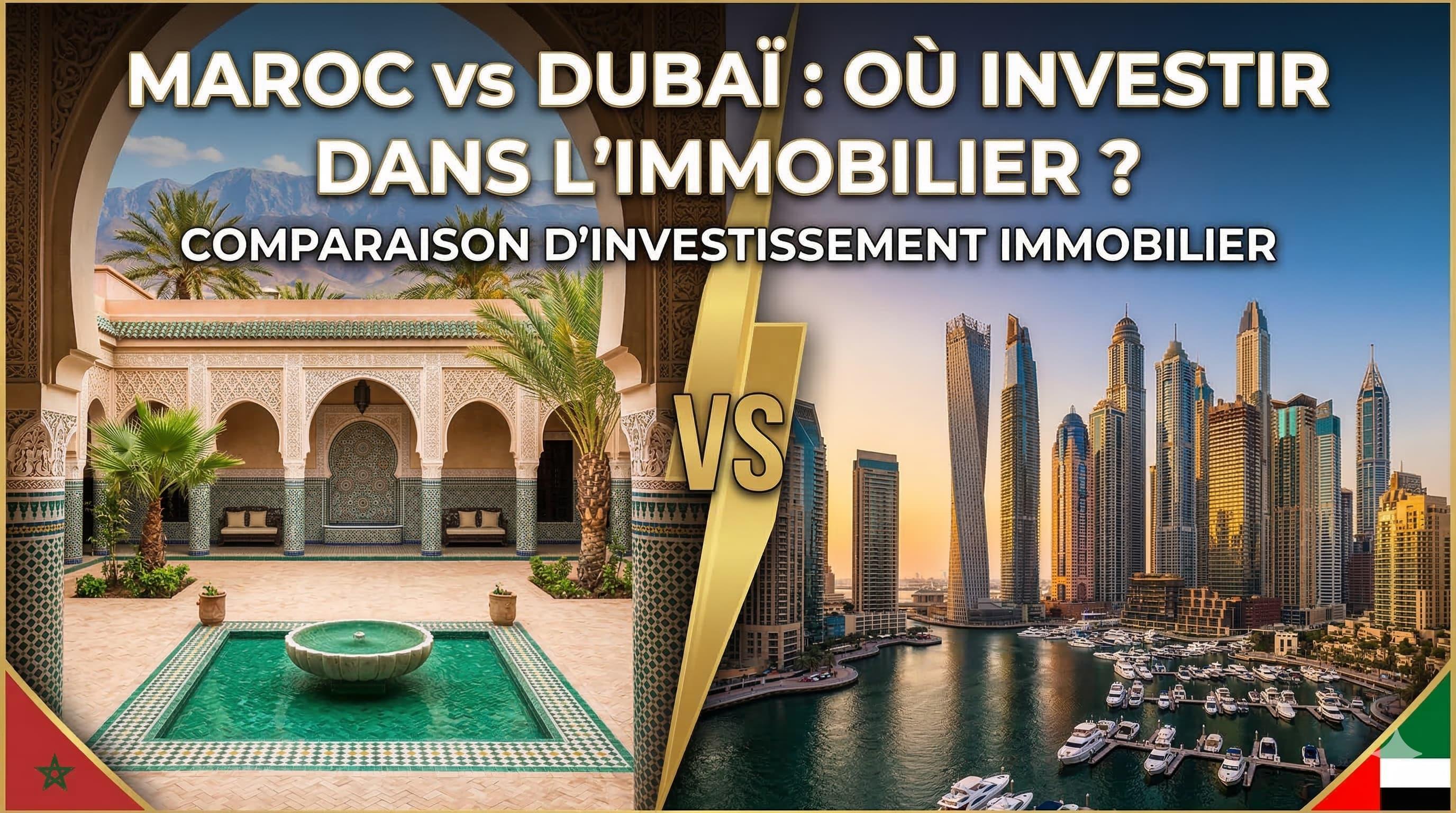
Morocco vs Dubai: Where to Invest in Real Estate When the Middle East Is at War
The conflict escalating across the Middle East in 2026 has sent shockwaves through regional property markets. Dubai, once considered untouchable as a global safe haven, saw missiles strike the Palm Jumeirah and forced the evacuation of the Burj Khalifa in February 2026. For international investors, the question is no longer theoretical: where do you put your capital when the region you trusted is under fire?
Morocco has emerged as the answer many are arriving at. Geographically removed from the conflict zone, politically stable, and offering some of the lowest acquisition costs in the premium segment, Marrakech is drawing serious attention from investors who have spent years building portfolios in the Gulf.
In this article, we compare Morocco and Dubai across the factors that matter most to international real estate investors: security, legal framework, rental yields, entry costs, and long-term upside.
Geopolitical Risk: The Factor That Changed Everything
Dubai's reputation as a safe haven was built over two decades of deliberate positioning. It survived the 2008 financial crisis, the 2014 oil slump, and the COVID-19 pandemic. What it had never faced was direct military targeting of its infrastructure — until now.
Iranian drone and missile strikes in early 2026 damaged Dubai International Airport, the Fairmont Hotel on the Palm, and residential areas. The Burj Khalifa was evacuated. Airport access was restricted to confirmed bookings only. For investors holding luxury assets in Dubai, this represented something no financial model had priced in: the physical vulnerability of the asset itself.
Morocco operates in an entirely different security context. The country has maintained political stability under King Mohammed VI for over two decades, has no involvement in any regional military conflict, and sits geographically at the opposite end of the Mediterranean from the current conflict zone. We see this as a structural advantage, not just a temporary comparison point.
Legal Framework for Foreign Buyers
One of the most common misconceptions about Moroccan real estate is that it is difficult for foreigners to buy. In practice, foreign nationals can acquire property freely in Morocco, provided the transaction is conducted in foreign currency converted through official banking channels. This mechanism legally guarantees the right to repatriate both capital and rental income at any time.
In Dubai, foreign ownership is permitted in designated freehold zones. The framework is well-established, but investors in off-plan projects have faced delays, developer insolvencies, and limited recourse in dispute resolution.
In Morocco, the key requirements are a valid titre foncier (land title) and, for villas and tourist projects, a confirmed Vocation Non Agricole (VNA). When these documents are in place — and we verify them systematically for every property we present — the transaction is legally clean and the buyer holds full registered ownership. We work with notaries who specialise in international acquisitions to ensure every step is properly documented.
Entry Costs and Price Per Square Metre
Dubai's price surge between 2021 and 2025 pushed prime residential values up 60 to 75%. A villa in Palm Jumeirah or Emirates Hills today requires a minimum commitment of $3 to $5 million, with transfer fees, service charges, and commissions adding 7 to 10% on top.
In Marrakech, a luxury villa on the Route d'Ourika or Route d'Amizmiz with a private pool, mature garden, and four to six bedrooms starts from approximately €400,000. Price per square metre for built space ranges from 5,000 to 8,000 MAD — a fraction of comparable Dubai pricing. Acquisition costs total approximately 7 to 9% of the purchase price, in line with international norms.
This means an investor can access a comparable lifestyle product in Marrakech for 30 to 40% of the Dubai price, while retaining significantly more capital for yield-generating activity or diversification.
Rental Yields: What the Numbers Actually Show
Dubai has historically offered gross rental yields of 5 to 7% in the luxury segment. Net yields in premium properties typically settle between 3.5 and 5% after service charges, management fees, and vacancy periods.
In Marrakech, the tourist rental model produces substantially higher returns. A well-managed luxury villa on the Route d'Ourika, let at €500 to €800 per night with a 45 to 55% occupancy rate, generates annual gross revenue of €80,000 to €130,000. After management fees, maintenance, and Moroccan rental income tax — which benefits from a 40% abatement for furnished rentals — net yields typically range from 7 to 10%.
Morocco also benefits from a growing long-stay segment — European remote workers and retirees seeking 30 to 90 day rentals — which improves occupancy during the traditionally softer spring and autumn months and reduces reliance on peak-season tourism alone.
Taxation: Morocco's Structural Advantage
Morocco imposes no wealth tax and no inheritance tax on real property held by foreign nationals. Rental income is subject to income tax, but the 40% abatement on furnished rental income means the effective rate is significantly lower than headline figures suggest. Capital gains (IPI) are assessed at 20% of the net gain and are fully exempt after five years of ownership — a clear incentive for medium to long-term holding.
Morocco has signed double taxation conventions with France, Spain, the United Kingdom, Germany, and several Gulf states, meaning investors rarely face double taxation on rental income or capital gains.
Dubai charges no income tax on rental earnings and no capital gains tax. However, the 4% DLD transfer fee, annual service charges on managed properties, and VAT introduced in 2018 have gradually eroded the UAE's tax-free advantage in practice.
Growth Catalysts: What Drives Marrakech Values Through 2030
Morocco's real estate market does not rely on a single catalyst. Multiple structural factors are converging to drive property values in Marrakech over the next four years.
The 2030 FIFA World Cup, which Morocco co-hosts with Spain and Portugal, has triggered €2 billion in infrastructure investment across host cities. Marrakech's Menara Airport is doubling capacity to 40 million passengers annually. A TGV high-speed rail extension will connect Casablanca to Marrakech in under 90 minutes by 2030. Morocco welcomed 17.4 million visitors in 2024, a 20% increase over the prior year, and the government's tourism strategy targets 26 million visitors annually by 2030.
New hotel and villa classification standards under the 2024 Arrêté 985-24 are raising service benchmarks across the sector, which benefits premium villa operators and short-term rental investors directly. Properties on the Routes d'Ourika, d'Amizmiz, and de Tahanaout sit in villa zones with strict height and density rules, which preserves both the character of the area and the scarcity value of the properties within it.
The Honest Comparison
Dubai remains a sophisticated, liquid market with a world-class regulatory framework. For investors who prioritise liquidity above all — the ability to sell quickly at fair value — Dubai's transaction volumes and international buyer base are difficult to match. If and when the current conflict stabilises, the market will likely recover as it has done after every previous shock.
But the risk profile has changed. What happened in February 2026 demonstrated that no Middle Eastern market, however well-managed, is immune to the consequences of regional conflict. Investors who held concentrated exposure to Dubai assets have spent recent weeks reassessing not the quality of their properties, but their geography.
Morocco offers something Dubai cannot currently provide: distance. Physical distance from the conflict zone, geopolitical distance from the parties involved, and a market that has been quietly building the fundamentals — infrastructure, tourism, legal reform, international connectivity — that generate durable property values. The entry price remains accessible. The yield is compelling. The window before the 2030 World Cup infrastructure uplift is still open.
Browse Our Current Villa Selection in Marrakech
We have been working with international investors and MRE buyers in Marrakech for years, and the volume of enquiries we are currently receiving from buyers who had previously focused on the Gulf is unlike anything we have seen before.
Browse our current villas for sale in Marrakech on the Routes d'Ourika, Amizmiz, and Tahanaout. Every property in our portfolio has been verified for titre foncier status and VNA compliance before we present it to buyers.
You can explore individual listings such as Villa Panorama on the Route d'Ourika (4 bedrooms, €855,000), Villa Tara also on the Route d'Ourika (5 bedrooms, €750,000), and Villa Ghislaine on the Route d'Amizmiz (5 bedrooms, €1,200,000) — for a concrete sense of what the market offers at various price points.
Contact our team via our contact page for a private consultation. We work with buyers from initial market assessment through to notarised completion, and we can connect you with financing specialists, tax advisors, and property management partners to structure your investment for maximum return from day one.
Calculate Your Acquisition Costs
Before committing to any property purchase in Morocco, it is essential to budget accurately for notary fees and acquisition taxes. These typically add 7 to 9% on top of the purchase price and vary depending on property type.
Use our free Morocco notary fees calculator to get an instant, accurate estimate based on your target purchase price and property type. The tool covers registration fees, land registry costs, and notary honoraria — all in one place, in your preferred currency.

Related Posts